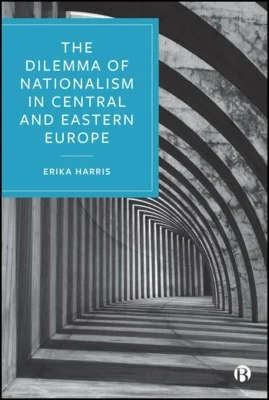
ERIKA HARRIS, The Dilemma of Nationalism in Central and Eastern Europe, Bristol University Press, 2026.
There are so many books on nationalism and nations that each new one should answer the question – why is it needed? Erika Harris’s book “The Dilemma of Nationalism in Central and Eastern Europe” was needed and it fully justified its existence.
Harris wrote a book that focuses on Central and Eastern Europe, understood quite broadly – through various historical changes. Empires and states, borders and status come and go, and with them individuals and communities suffered, especially those who, with the collapse of the previous system or the disappearance of the previous state, changed their status from a “core people” to an oppressed – attacked or disenfranchised, and in some cases even expelled – community that found itself outside its “home state”. Those communities, on the other hand, that did not have their own state – because they were unwanted in the states in which they found themselves, or because, like Jewish and Roma population, they were stateless – suffered, sometimes completely, in events for which they were not responsible and which they did not wish. This happened in the wider European space – everywhere – just as today nationalism, ethnic hatred, threats and extremism cannot be limited to just one part of that “dark continent” (as Mark Mazower called it in the title of his book back in 1998 ). But on the edges of old empires, where people are mixed, where they speak multiple languages although none of them is “correct” by the standards of nationalist language purists, where the boundaries between “Us” and “Others” are not firm, where there is a long tradition of neighborhood but episodes of previous conflicts are frequent, the dangers are greater than elsewhere.
About these dangers, about the importance of previous conflicts and their reinterpretations, about the violence that arises from the desire to apply “pure” concepts of nation and state to ethnically pluralistic territories, Erika Harris writes a book that questions – in the light of these experiences – the usual understanding of concepts such as nation, nationalism, state, identities, etc. This study is academic in nature, precise and careful in its use of concepts, sources and literature, but it is also personal, arising from her own experience and family history. Harris was born into a Jewish family in which both parents survived Auschwitz, and thus for her too – as for numerous other Jews from the region where she was born (Subcarpathian Rus, today in eastern Slovakia, and once in Hungary, then in Ukraine) – nationalism in its extreme form caused painful losses. Almost her entire extended family perished in the Holocaust, as did many other Jewish families—so much so that, at the beginning of elementary school, her mother explained to her that Jewish children had no grandparents, while all the other children did. Writing an academic book partly from an autobiographical perspective, the author follows the popular trends of writing micro-history and local history, using both personal insights and memories of the area where she grew up.
But nationalism arises not only in relation to the state, but to the nation, and the nation is not only a category of thought and identity, but is also a territorial unit. The territory of a nation is not the same as the territory of a state, so where there are many “ours” in another country and many “theirs” in ours, nationalism finds its reason d’etre , and we could say it also becomes a perpetuum mobile.
DEJAN JOVIĆ, FOREIGN POLICY FORUM PRESIDENT OF THE BOARD
That approach then leads to challenging of simplified expectations, for example, the possibility of demarcating or identifying a nation with a state, as well as a dilemma regarding, for example, the irrelevance of national feeling and memory in a future – removed from traumatic events. Its starting point is precisely that the terms “nation/people” and “state” cannot be equated, because they often do not overlap. A nation (people) has its borders, its rules of access, its content – which is different from the rules and borders of a “state”. “Nation-state”, the term that connects the nation and the state, is a concept that may be understandable in the West, but in Central and Eastern Europe it does not make much sense.
Harris is deeply concerned with the importance of past events in shaping the present. Past events cannot be forgotten – they always resurface, even when they are deliberately suppressed or denied, within the framework of the new “historical revisionism” that the author addresses in the second part of this book. She asks – how is it that nationalism has remained so relevant even after the independence of numerous small nations in the region? Why and how did it happen that the mere creation of states is not enough for nationalism to retreat, since it has now achieved its goals? But nationalism arises not only in relation to the state, but to the nation, and the nation is not only a category of thought and identity, but is also a territorial unit. The territory of a nation is not the same as the territory of a state, so where there are many “ours” in another country and many “theirs” in ours, nationalism finds its reason d’etre , and we could say it also becomes a perpetuum mobile.
“Nationalism is a movement for collective action on behalf of the nation; even if the quest for national sovereignty is satisfied, the role of nationalism is to continue to consolidate the nation-state and to maintain the nation’s cultural and political identity,” says Harris. The main goal of nationalism is that the nation (that is, the people) that identifies itself as such, becomes the master of its collective destiny. It is crucial that the nation has its real and imagined (ideal) borders, so nationalists believe that securing dominance within these borders is their primary task. Since there is no identity between existing states and nations, Harris analyzes this relationship through new categories that she introduces into political science. These are: “shrunken state” and “stretched nation”. A shrunken state is left with a smaller territory than the territory of the nation it nominally represents. These are, for example, Hungary, Russia and Serbia (we assume Croatia too – given the Croats in Bosnia and Herzegovina and elsewhere in the surrounding countries). On the other hand, an extended nation is one whose significant parts live in other countries, in which they are not the “core group” rather than “non-core” group , a term Harris uses to avoid the term minority, drawing on the way Harris Mylonas defined these terms in his book The Politics of Nation -Building (2012). In political terminology – where they are not “nation” (a term that itself has many meanings, often opposing each other). This shrinking on the one hand and the stretching on the other is the result of historical circumstances, the interpretations of which are therefore at the very heart of defining the nation and the state. However, awareness of them, and the way in which they are relevant in modernity, arises from politics, from the need to point out the frustrating mismatch between the territory of the nation and that of the state. Since both categories are related to territory, and only one has clear borders (the state), nationalism is necessarily associated with the struggle for space. The mismatch of the borders of the nation and the state creates the thesis that our people were victims in the past, and sometimes – or even often – a pledge that this historical injustice will one day be “corrected”. In the case of Kosovo, for example, Filip Ejdus writes about how the secession of Kosovo from Serbia (de facto in 1999 and then through the unilateral declaration of independence even de iure in 2008) is used to perpetuate and strengthen nationalist pledges as well as theses about sacrifice for the nation in Serbia. (See his: Crisis and Ontological Insecurity – Serbia’s Anxiety over Kosovo’s Secession; 2020).
She also asks – should we not put less effort into debunking historical myths and establishing the truth based on facts, and more on questions such as: how and why did it happen that frustrations arose, that humiliations and betrayals are spoken of and that a narrative built on this calls for returning to the old “age of national glory and pride”?
DEJAN JOVIĆ, FOREIGN POLICY FORUM PRESIDENT OF THE BOARD
In order to keep the desire for the unity of the nation alive and attractive, nationalism tries to create cultural homogeneity, that is, a cross-border collective identity based on a common sense of belonging. Nationalists are therefore not satisfied with “ethnic roots” of the nation only, i.e. the fact that members of the community have a common origin or ancestors. This makes them ethnic group. But in order to become a national community, more is needed – it is necessary to create a coherent unit (an entity, a community) that shares not only genes and roots but also feelings of political oneness in the present. Therefore, Harris considers it important to point out that nationalism remains a political ideology, because it politicizes the ethnic in order to turn it into a nation. The nation is a category of modernity, as Gellner says – but, adds Harris, the central theme of nationalism is how to “galvanize nations for political action, including violent action”. This is achieved by using the past, including the most distant one. “The past is the engine that drives nationalist mobilization: ethno-histories, grievances about the past, national traumas, defeats and victories… The past creates a ‘cognitive map’ that guides ethno-national groups through history – without much regard for how far back one goes. In nationalist discourse,” says Harris, “the past and the present need to merge into a single national narrative in which the priority is neither historical context nor historical accuracy. The priority is – the present goal” (43).
Therefore, Harris concludes that nationalism is inevitably and inextricably linked to history, because it insists on a correct (from the point of view of today’s objectives) story that serves to bind the nation into one. However, she also asks – should we not put less effort into debunking historical myths and establishing the truth based on facts, and more on questions such as: how and why did it happen that frustrations arose, that humiliations and betrayals are spoken of and that a narrative built on this calls for returning to the old “age of national glory and pride”? In other words, Harris believes that it is futile to prove that current interpretations of the past are incorrect – because the point is not to be correct, but to be useful.
Another category that Harris promotes in this book is that of the “sudden nationness” – which hastily overturned previous attempts to manage complex identities and instead promoted a policy of demonizing the Other. This category is useful to understand the sources of nationalism that was given the opportunity to form a state and consolidate a nation in circumstances that occurred without order or plan, and which for many were unexpected. Again, good cases are that of Hungary, Russia and Serbia – but in a wider sense: most of Central and Eastern Europe.
The West underestimates the connection between the main principle of nationalism – that the borders of the state and the nation should coincide – and the idea of changing borders. Separatism, irredentism, the desire to unite parts of the nation in order to achieve the “territorial integrity” of the nation – all these options are still open and waiting to take advantage of a crisis or the eventual collapse of the international order.
DEJAN JOVIĆ, FOREIGN POLICY FORUM PRESIDENT OF THE BOARD
Although the emphasis of the book is on Central and Eastern Europe (which Harris believes are still relevant concepts, as well as the concept of post-socialism, regardless of the fact that she accepts that this may one day cease to be the case), she opposes the (essentially orientalist) thesis that nationalism is something endemic, related only to areas outside the West (eg Western Europe). “Contrary to expectations, European integration is not synonymous with diminishing the importance of ethnicity, and in some cases it is even responsible for encouraging it. EU expansion to the east did not destroy the politicization of ethnicity, even when it successfully reduced inter-ethnic tensions” (122). Otherwise, how could we explain the Hungarian policy of extending the nation to those Hungarians who live outside the borders of Hungary but within the borders of the EU? While such strengthening of ethnic ties between a mother-country outside the EU and one inside (or vice versa) makes some sense as a response to the increasingly rigid external border of the European Union, in the case of Hungarians in Romania, Croatia or Slovakia this is not the reason. The Hungarian case of a “shrunken state” and a “stretched nation” is the result of border changes in the past that has not been forgotten and is constantly used to renew Hungarian nationalism.
The West underestimates the connection between the main principle of nationalism – that the borders of the state and the nation should coincide – and the idea of changing borders. Separatism, irredentism, the desire to unite parts of the nation in order to achieve the “territorial integrity” of the nation – all these options are still open and waiting to take advantage of a crisis or the eventual collapse of the international order. We should concentrate more on the question of “what nations do” than how they came to be, says Harris (137). In addition, it should be accepted that nationalism has gained a bad reputation – and not without reason (a very bad name for very good reasons, 138), although it is very successful and it has survived the expectation that it will disappear in the process of strengthening globalization.
Separating the concepts of nation and state, Harris indicates that the process of building a nation takes place even when a nation does not have its “own” state, or it has one within the framework of a multinational state. The example of Yugoslavia is instructive in this sense. She wonders: “Does anyone really believe that the former Yugoslavia did not consist of nations that were increasingly persistent in trying to become independent states as soon as the state they were in disappeared?” (142). In a special chapter of the book, she focuses on the case of Serbia and the Serbo-Croatian war in the 1990s. Her analysis tries to penetrate into the reasons why actors in that war – especially Serbia – used real tragedies from their own past to construct new narratives about a victimized nation, historical injustice and the need to prevent new trauma. Why did they decide to – instead of reducing tensions – work on increasing them? Theories about ethnic and civil nationalism do not help in explaining this.
In the last part of the book, Harris deals with Russia and Ukraine, and contemporary historical revisionism that equates “communism” with “fascism/nazism”, thereby diminishing the significance of the Holocaust. Revisionists downplay or deny the intensity of collaboration with nazi occupiers in World War II, while at the same time emphasizing that “communism” was just as criminal as fascism. They also reject and deny any responsibility of local nationalist-collaborators (Ukrainian, Slovak, Croatian, etc.) for the crimes committed in that war, attributing them exclusively to external (international) circumstances, shifting responsibility for them to the occupiers. In reality, however, the collaborationists were sometimes even more brutal towards minorities (Harris primarily focusses on Jews, but also mentions Serbs in the NDH and other cases of genocidal treatment of degraded and unwanted communities) than the occupiers.
“The association of fascism and communism diminishes Nazi crimes and magnifies ‘communist’ ones (as emphasized by ultranationalists), and promotes the thesis of a ‘double genocide’, as is the case in Lithuania” (221). Such a policy speaks of the suffering of Lithuanians, but not of Jews – who are no longer there, so it is “easy” to silence them. But, silencing the victims of the Holocaust and genocide is a new way of their actual victimization.
DEJAN JOVIĆ, FOREIGN POLICY FORUM PRESIDENT OF THE BOARD
On the other hand, the new Russian identity (after the collapse of the Soviet Union) is built on the idea of victory in the “Great Patriotic War” (1941-1945), and on the idea of protecting the Russian community living outside of Russia. In both cases, that identity is built on a significant manipulation of history, as seen in the case of Russian war against Ukraine (189). Contemporary “needs” serve as a reason for the “awakening” of old conflicts, and therefore in the case of Ukraine there is talk of “denazification” and not just demilitarization. On the other hand, Ukrainian nationalism glorifies collaborationists such as Stephan Bandera, considering that any past situation in which Ukraine was independent from Russia was justified, regardless of the character of the regime and the type of crimes committed. The Holocaust is therefore minimized or denied, and the rejection of socialism (communism) has opened the door wide to the rejection of the importance and positivity of anti-fascist resistance.
Harris looks at both nationalisms – both Russian and Ukrainian – noting that both reshape previous interpretations of the past, and concludes that post-socialist processes of democratization are sooner or later also nationalistic, or linked to nationalism. Victory over “communism” is not enough to make a country “European” or “Western” (201). Denial of participation in crimes against the Jewish population makes contemporary nationalism in Eastern Europe distinctly revisionist. The author cites the example of Poland – which in 2018 passed a law punishing anyone who publicly accuses Poles of being responsible (or co-responsible) for crimes committed by the Germans in Poland during World War II. This “absolves” Poles of any responsibility for aiding and abetting anti-Jewish violence, which resulted in only one percent (out of three million) of Polish Jews surviving the war. Narratives that justify collaboration, passive observation (stand-by ) or approval of ethnic cleansing and genocide are further strengthened by the fact that the massacre in the Katyn Forest is now considered the greatest tragedy that happened in Poland in that war – and it even goes so far as to blame communism for Auschwitz.
A similar situation occurred in Lithuania, where 220,000 Jews lived before the war, seven percent of the total population. The occupation – first by the USSR and then by Germany – led to the deaths of as many as 95 percent of them. Domestic collaborationist forces also participated in the persecution, who welcomed the German occupation as a “liberation” from “communism”. Today, these collaborationists are celebrated as “freedom fighters” against the Soviet occupation, while their role in the Holocaust is completely ignored – as if it were completely unimportant. Those who sided with the anti-fascists and fought against the German occupation and domestic collaboration are now harassed and sometimes imprisoned and prosecuted as “communists”. “The association of fascism and communism diminishes Nazi crimes and magnifies ‘communist’ ones (as emphasized by ultranationalists), and promotes the thesis of a ‘double genocide’, as is the case in Lithuania” (221). Such a policy speaks of the suffering of Lithuanians, but not of Jews – who are no longer there, so it is “easy” to silence them. But, silencing the victims of the Holocaust and genocide is a new way of their actual victimization.
This conclusion by Erika Harris is important because it also describes the situation in many other countries, where minorities – especially those that have practically disappeared – are completely excluded from the “collective Us”. They are excluded because their history is unwanted, because the attitude towards them appears as a stain on the conscience of the core nation, a stain that does not disappear but breaks through numerous layers of deliberate denial and “forgetting”. The example of the exclusion (“erasure”) of the Jewish experience – or the Italian and Serbian after the wars in Croatia and Yugoslavia – shows that nationalists do not mean all citizens equally by “Us”, but only members of their nation. They are not interested in the experience of others, towards which they remain indifferent, especially if they treat these others as opponents and enemies. They enemize their victims (by turning them into enemies) in order to justify their participation in aggressive actions against them. They always present themselves as victims, and use the victim status as a justification for attacks on others, whom they accuse of disloyalty. Non-belonging, however, is not a matter of the refusal of these smaller communities to participate in the whole, but of the desire of the nationalists of the majority group to exclude them from the whole. We could say that nationalists oppose not only integration but also assimilation – and that they prefer the dissimilation, exclusion and subjugation of those communities that they designate as historical and current (and therefore permanent, i.e. also future) enemies.
In order to show what the processes of exclusion and destruction of a small community (Jewish) really look like, the author focuses in the last part of the book on Slovakia, including primarily the region from which she herself comes. However, her analysis also describes really well the situation in Hungary, Croatia, Poland, Ukraine, Russia, and the Baltic countries. In all of them, historical revisionism is currently flourishing, the aim of which is to rehabilitate nationalist-collaborators, in order to justify the crimes committed against Jews and other minorities and communities.
Erika Harris’s book brilliantly combines theoretical aspects with case studies. Challenging and provocative in the best sense of the term, it identifies the “blind spots” of nationalism and the theory of nations. The author uses personal family history to illustrate how nationalism operates in small communities which cannot escape big issues and global confrontations, ideological extremism and violence. The autobiographical aspects make her academic analysis even more relevant. The book strongly opposes the simplistic claims of those who have no insight into (or ignore as unimportant) the experience of living on the dangerous borders of nations, empires and new states. This exclusion of Central Eastern European experiences is essentially “Orientalist”. Erika Harris brings these experiences back to the center of the story of nation and nationalism. For this reason, this book deserves every praise.
Dejan Jović
University of Zagreb
—
This book review is written as part of research activities conducted within the EU-funded project (Next Generation EU) “Politics, Society and Communication in Southeast Europe” (POD-RUKOM).